
Digital media
Today most children and young people grow up with digital media as a natural part of their everyday lives.
For many people, social media, digital games and streaming feel entertaining, stimulating or relaxing. But because of how digital media are designed and how the companies behind them make money, there are built-in risks that affect young people today. Research clearly shows that using digital media can carry a risk of poorer mental health.
The page in brief
- Most children and young people use phones, games and social media every day.
- Most of the time it is fun and relaxing, but there are risks for how you feel.
- The risks are about three things: how much time it takes, what you look at, and when, how and why you use the screen.
- People often feel worse after seeing content with hate and threats, disturbing images, unrealistic beauty ideals, a focus on weight, or self-harm.
- The Public Health Agency of Sweden recommends no more than 1–2 hours of screen time a day for children aged 6–12 and no more than 2–3 hours for young people aged 13–18.
- Screen time should not take time from sleep, movement and other important things.
Which kinds of use are linked to a risk of mental ill health?
Everyone is different and is affected differently by their use of digital media. But if you sum up the patterns across the population, you can identify three ways of using digital media that are linked to poorer mental health.
Time
Too much screen time can crowd out sleep, movement and other important recovery.
Content
Negative content online can affect self-image and wellbeing, especially on social media.
Context
The effect of digital media on how we feel depends on where, when and why they are used.
Time
Using digital media for so much of the day that it crowds out our other basic needs, such as the slices in the Mental Health Plate. There are only 24 hours in a day, and if you spend 6 hours on digital media (which for many people is a kind of chill time), there is a big risk that you will not have enough time for your other basic needs, such as sleep, exercise or other meaningful activities.
1–3hrs
That is why the Public Health Agency of Sweden recommends no more than 1–3 hours of screen time a day for children aged 6–18, depending on age.
There are only 24 hours in a day
Screen time per day
- Sleep (ages 13–18)9 hrs
- Screen6 hrs
- Left for school, exercise, relationships, meals and everything else9 hrs
With 6 hours of screen time and 9 hours of sleep, you have 9 hours left for everything else.
The Public Health Agency of Sweden’s rule of thumb for children’s and young people’s screen time
- Ages 0–2NoneNo screen time
- Ages 2–5Max 1 hrNo more than 1 hour a day
- Ages 6–121–2 hrsNo more than 1–2 hours a day
- Ages 13–182–3 hrsNo more than 2–3 hours a day
Content
glowupdaily
Beauty ideals
“How to get perfect skin and a tiny waist in a week”
Showing less. You will see less of this kind of thing.
anonymous_42
Mean comments
“haha look at what he looks like”
Reported. The app will review the comment.
crashclips
Scary videos of injuries
Video: accident on the ski slope
Showing less. You will see less of this kind of thing.
unknown_user
Threats
“You’re going to regret this”
Blocked. The account can no longer contact you.
unknown_user
Blackmail
“Send the picture, or I’ll share it”
Blocked. It’s good that an adult knows about it.
Coming across content online that affects your thoughts, feelings and self-image in a negative way. Social media are more often full of content that makes us compare ourselves with others, and research shows a stronger link to poorer mental health for social media than for computer games, for example.
Examples of negative content
Apps show more of what you linger on.
Research shows that people often feel worse after seeing content featuring:
- Hate, threats and harassment
- Disturbing images, accidents and violence
- Unrealistic beauty ideals
- Food with a focus on calories, health and weight
- Self-harm
Unfortunately, this is very common on social media and hard to avoid completely. Read more about the research in the Public Health Agency of Sweden’s research summary and in the report on social media, eating disorders and self-harm that we wrote for the Swedish Agency for the Media (both in Swedish).
Worried about an eating disorder? Read about where you can get help.
Tips for retraining the feed and reporting illegal content:
- Reset the algorithm. On some platforms you can give the algorithm a fresh start. Read more here (in Swedish).
- Retrain the algorithm. Influence your content by pressing “see less” on content you come across, and do not linger on things you do not want to see more of.
- Report illegal content or breaches of the DSA (Digital Services Act) to the platform, or make a complaint to the Swedish Post and Telecom Authority (PTS), which is Sweden’s Digital Services Coordinator.
- Report crimes to the police (in Swedish).
- Try cleaning up toxic content with Detoxify.
Retrain the feed: press the buttons in the posts and see what happens.
The Public Health Agency of Sweden has more advice for parents on how to talk about and influence what children see.
Context
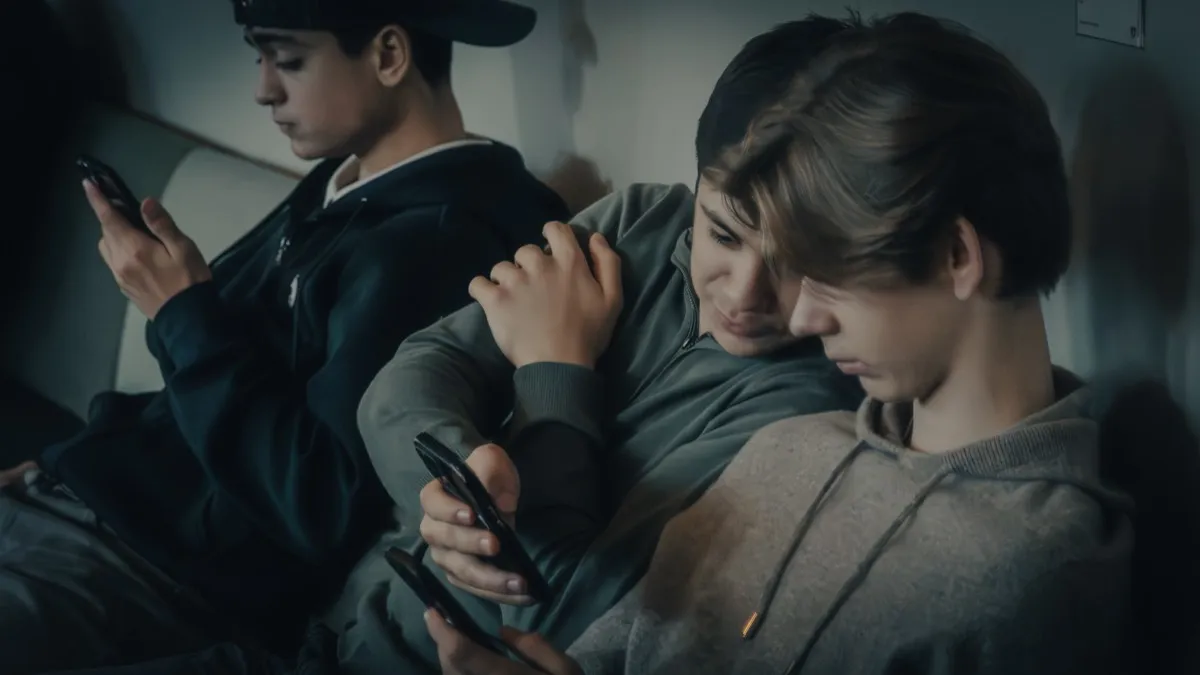
The same amount of screen time can affect you differently depending on where the phone is, when it is used and why.
Where?
A phone within reach draws attention even when it is silent. At homework time, at dinner and in bed, it becomes harder to focus, be together and fall asleep. Put it in another room and turn off notifications.
When?
Late in the evening and at night, the screen takes time from sleep. Picking up the phone every time you are bored gets you used to quick rewards. Other things then feel more boring, and it becomes harder to put up with your own thoughts.
Why?
Why you pick up the phone matters.
Usually good
- Keeping in touch with friends you already know
- Learning things
- Having fun
Increases the risk of addiction, anxiety and low mood
- Escaping difficult feelings
- Chasing status and approval
- Replacing friends in real life with friends online
A simple trick when you get stuck: turn the screen away and count to ten. Then ask yourself whether you are doing this because you want to, or to avoid something else.
Can you become addicted to digital media?
If you use digital media in a way that causes problems in your life and you find it hard to control your use, it may be a sign of addiction. At present there is a formal addiction diagnosis only for gaming, but signs of social media addiction are now more common. Everyone is of course different, but research has identified some characteristics that carry a particular risk of developing an addiction to digital media. The following characteristics carry a higher risk:
Digital games
Being a boy, having a neurodevelopmental condition (for example ADHD, autism, Tourette’s), having low impulse control and difficulties in other areas of life.
Social media
Being a girl, having low self-esteem, caring a lot about appearance, having poorer mental health.
This means that even though digital media can be an important part of a young person’s life, children with these vulnerabilities need even more support in their use of digital media. For specific guidance for parents of children with neurodevelopmental conditions, there are tips summarised on the Public Health Agency of Sweden’s website.
Sources
- The Public Health Agency of Sweden’s research summary (2024, in Swedish)
- Guidance for parents of children with disabilities or special needs (in Swedish)
- Report on social media, eating disorders and self-harm (2026), the Swedish Agency for the Media (in Swedish)
- Beknazar-Yuzbashev et al. (2025): Toxic Content and User Engagement on Social Media: Evidence from a Field Experiment, CESifo Working Paper 11644
- Föräldrakollen: step-by-step guides with practical tips for settings (in Swedish)
Want to set limits together?


Want to work with this at school?
Det syns inte is a school programme about mental health, the brain and life with screens. It is built on drama films and research, and is used by teachers, mentors and school health teams together with the students. The programme’s website is in Swedish.